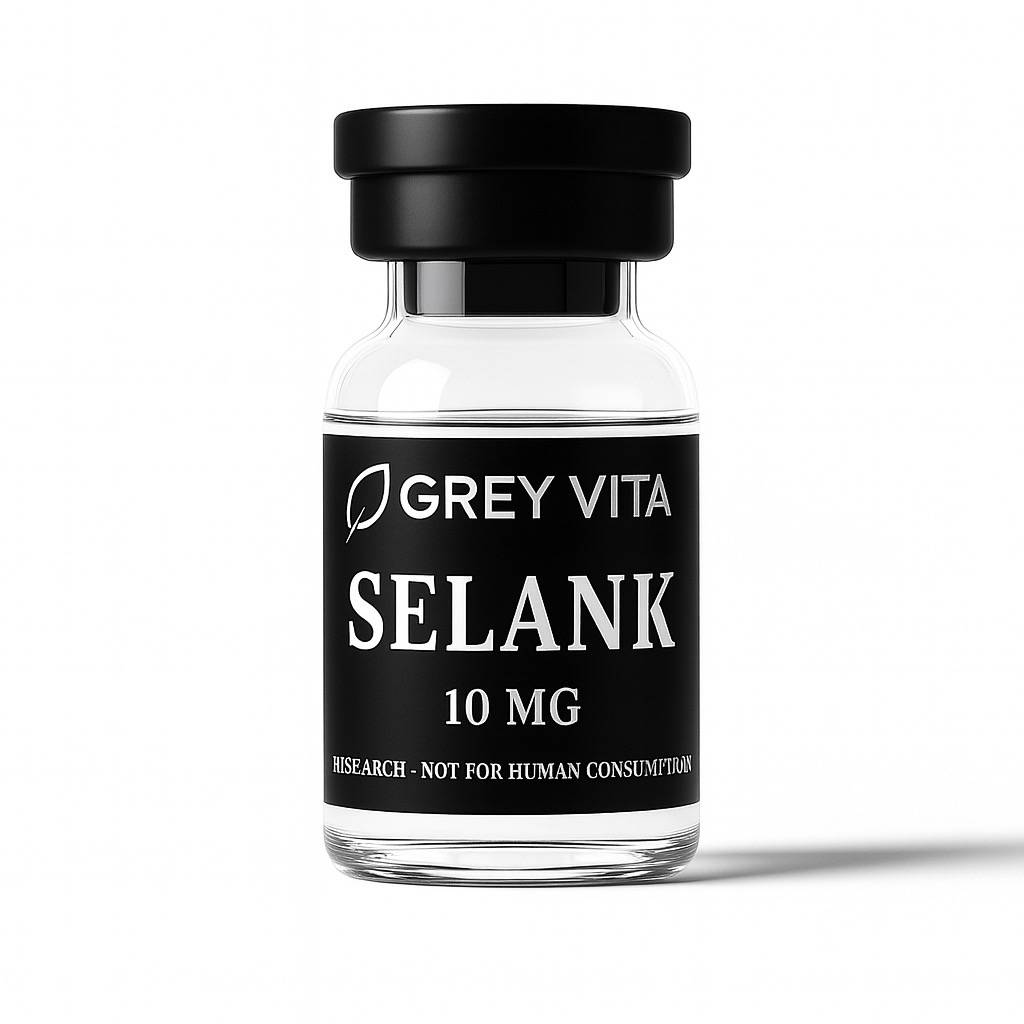
Selank 10MG
CAS Number: 129954-34-3
In Stock
Selank – Research Overview
Chemical name: Thr-Lys-Pro-Arg-Pro-Gly-Pro
Common research name: Selank
Class: Synthetic heptapeptide / Tuftsin analog
Sequence: TKPRPGP
Primary targets: GABAergic modulation (calming neurotransmitter system) and immune-neuropeptide pathways
Molecular weight: ~863 Da
Selank is a synthetic analog of the endogenous peptide tuftsin (a natural immunomodulatory peptide).
It has been investigated in preclinical studies for its effects on:
Anxiety-related behavior (anxiolytic-like effects in animals)
Stress response
Cognitive function (learning and memory in rodent models)
Immune modulation
Monoamine neurotransmission (serotonin, dopamine, norepinephrine systems)
All findings refer to animal and in-vitro models, not established human outcomes.
Molecular & Pharmacological Profile
In experimental systems, Selank has been shown to:
Modulate GABAergic transmission (influences the main calming/inhibitory neurotransmitter)
Affect monoamine levels (serotonin, dopamine, norepinephrine – mood and focus pathways)
Interact with tuftsin receptors (immune and nervous system signaling)
Influence expression of Brain-Derived Neurotrophic Factor (BDNF) in some models (supports neuronal health and plasticity)
Show anxiolytic-like and nootropic-like profiles in rodents (reduced anxiety-like behavior and improved learning in animal tests)
These characteristics make Selank a common subject in neuropsychopharmacology and neuroimmune research.
Mechanism of Action (Preclinical)
Selank’s exact mechanism is still being clarified, but several key preclinical mechanisms have been identified:
- Modulation of GABA System
Selank appears to enhance GABAergic activity
(supporting the brain’s primary calming/inhibitory system),
which may explain its anxiolytic-like (anti-anxiety–like) effects in animal models. - Effects on Monoamine Neurotransmitters
Preclinical data show Selank can:
Influence serotonin metabolism (mood and anxiety regulation)
Affect dopamine and norepinephrine levels (motivation, focus, arousal)
(these are research findings, not clinical claims). - Tuftsin Receptor Interaction
Because it is a tuftsin analog, Selank interacts with tuftsin-sensitive pathways
(bridging immune and nervous system signaling). - Neurotrophic & Gene Expression Effects
Some studies report:
Increased BDNF expression (a key growth factor for neurons)
Changes in expression of genes related to stress response and synaptic plasticity
(how neurons adapt and form new connections) - Immunomodulatory Activity
Selank has been shown to:
Influence cytokine balance (immune signaling molecules)
Shift immune responses toward a more regulated profile in animal models.
Preclinical Research: Potential Applications
Selank has been investigated mainly in rodent and in-vitro models, including:
- Anxiety & Stress-Response Models
Reduced anxiety-like behavior in elevated plus maze and open-field tests
Improved behavioral response under chronic stress conditions
Stabilization of stress-induced changes in neurotransmitters
(These are behavior tests in animals, often used as proxies for anxiety research.) - Cognitive & Nootropic Research
Improved learning and memory performance in maze and conditioning tasks
Enhanced attention and information retention in some paradigms
Support of BDNF and synaptic plasticity–related pathways
(suggestive of pro-cognitive effects in research models) - Neuroimmune & Inflammatory Models
Modulation of pro-inflammatory vs anti-inflammatory cytokines
Potential normalization of immune disturbances under stress
Interaction between nervous and immune systems (neuroimmune axis) - Antidepressant-Like and Anxiolytic-Like Profiles (Preclinical)
Behavioral patterns similar to anxiolytic compounds in animals
Some antidepressant-like effects in rodent tests (forced-swim, tail-suspension–type paradigms)
(Again: preclinical behavioral research, not established human therapy.)
Efficacy Observed in Preclinical Models
Behavioral Studies (Rodents)
Reduced anxiety-like behavior in standard tests (more time in open arms, reduced freezing, etc.)
Enhanced exploratory behavior (animals more willing to explore novel environments)
Better performance on learning and memory tasks (faster acquisition, better recall)
Biochemical / Molecular Findings
Increased GABAergic tone (more inhibitory/calming signaling)
Modulation of serotonin and dopamine turnover
Upregulation of BDNF and other neurotrophic factors in some brain regions
Adjusted cytokine profiles and immune markers under stress
Stress-Model Outcomes
Reduced negative behavioral impact of chronic mild stress
Normalization of certain stress-induced neurotransmitter changes
All of the above are limited to preclinical research.
Safety & Tolerability (Preclinical)
Across available animal research:
Selank has shown low toxicity at standard experimental doses
No major organ toxicity reported in rodent studies
No strong sedative or motor-impairing effects
(animals typically retain normal locomotor activity)
Long-term safety in humans has not been established
Not evaluated or approved by major regulators as a therapeutic agent
Regulatory Status & Disclaimer
Selank is an investigational research peptide.
It is not approved by the FDA or other regulatory agencies for medical, dietary, or cosmetic use.
For Research Use Only.
Not for human consumption.
Not for veterinary use.
Not for diagnostic or therapeutic purposes.
No medical claims are made or implied.
Researchers are responsible for compliance with all applicable laws and regulations in their jurisdiction.
Key References (Preclinical)
Ashmarin I.P. et al. Tuftsin-derived peptides and neuroimmune regulation. Neurosci Behav Physiol.
Neznamov G.G. et al. Selank: Neuropsychopharmacological profile in preclinical models. Bull Exp Biol Med.
Gudasheva T.A. et al. Selank and GABAergic modulation in anxiety models. J Neurochem.
Medvedev A.E. et al. Effects of Selank on BDNF expression and stress response pathways. Neurochem J.
Kozyrev S.A. et al. Immunomodulatory and anxiolytic-like effects of Selank in rodents. Int J Neuropsychopharmacol.
Selank is a synthetic peptide that is known for its anxiolytic (anti-anxiety) and nootropic (cognitive-enhancing) effects. It is a synthetic analog of the naturally occurring peptide tuftsin and was developed in Russia, where it is approved for anxiety and cognitive enhancement, though it is not approved by the U.S. Food and Drug Administration (FDA) for any condition. Potential benefits include reducing anxiety without sedation, improving memory and focus, and supporting mood stability